Monday, September 30, 2013


Water and Motion Investigation

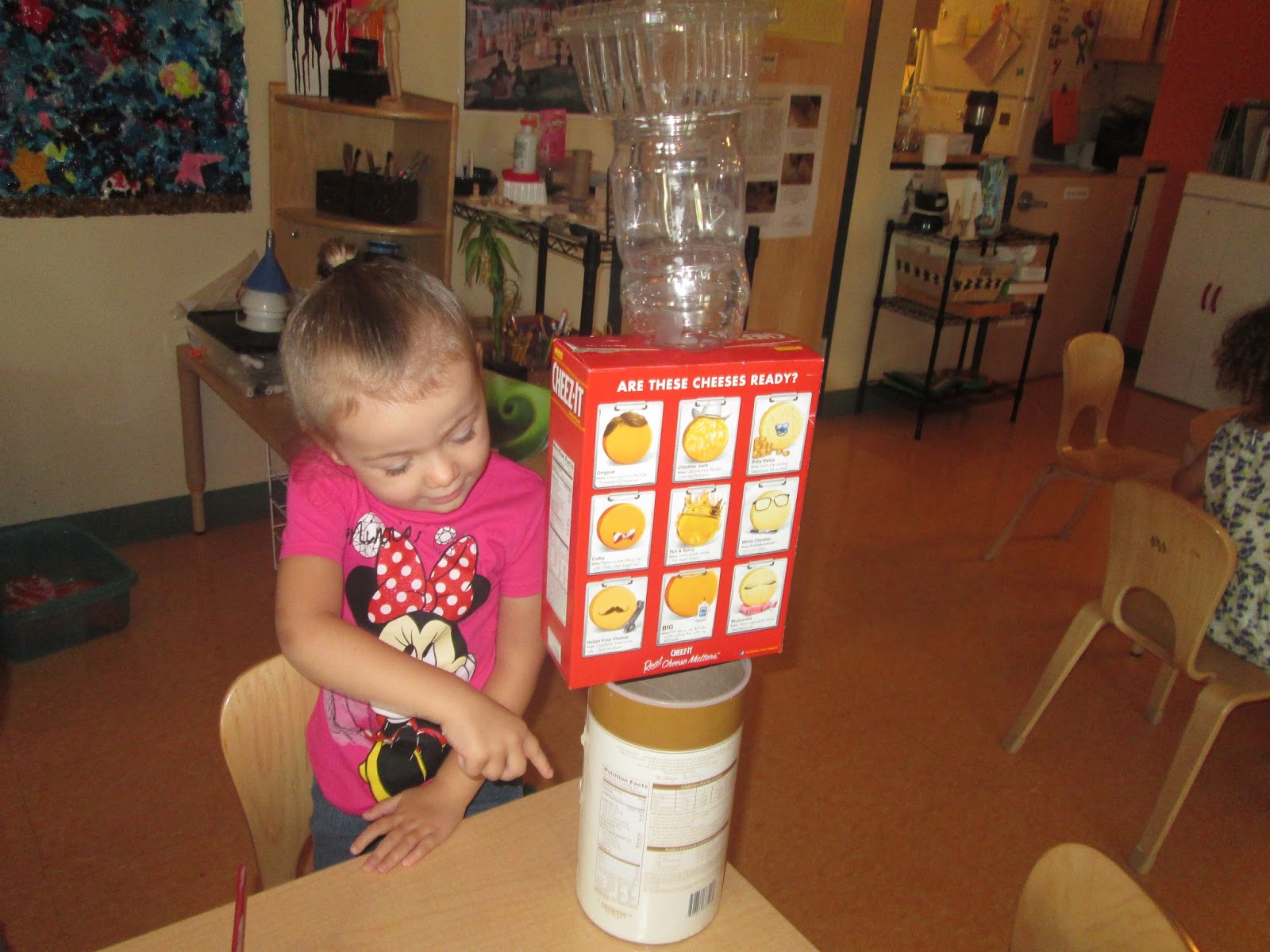
The children have been very interested in how the water travels through the tubes. We provoked the children’s interest with the water table, colored water, the plexi-glass hole insert, plastic expandable tubes, and plastic cups. The children began their investigation by scooping up the colored water in their cups and pouring it into the tubes. The children observed how the water traveled through the tube until it reached the other end.

“It’s coming back out!”-  Tyren

The children discovered how they could use one cup to pour the water into the tube and another cup to catch the water. Hadi worked on connecting two of the tubes together.

The plastic tubes provided the children with more control of changing the shape of the tube and the length of the tube.  We wanted to extend the children’s ideas about the movement of water by providing them with PVC pipes, instead of the flexible plastic tubing.  Right away, the children noticed the differences in the PVC piping.

“I can’t see the water”- Tyren

The children observed how if you poured the water through the L shaped pipe, the water wouldn’t always come out the other end on its own.  When a teacher asked Calvin, “How come your cup won’t fill up?” He stated:

“Because it is going out. If it is not the same direction, it needs to go up or down.”- Calvin

Calvin realized the pipe needed to be straight in order for the water to easily travel from one end to another. Calvin worked tilting the PVC pipe until the water came out the end. Caden discovered how if he flipped the PVC pipe upside down, the water would come out. 


Friday, August 30, 2013

Welcome to our Class!

We are excited to start the school year. Here are some photos from the open house yesterday.


Wafic and Hamoude discovered that they both liked the trains. Naasir joined in and added some tunnels.

 The art table was the perfect size for building and drawing. Sara and her sister built with blocks, while Tyren and his family drew pictures.


 The sand table was also a very popular activity. The children discovered that they could change the intensity of the light by moving the sand around the tray.

Thursday, August 1, 2013


 Week 4
 Bridges and Boats

Bridges
 Last week, we began
our exploration of bridges by discussing the structure of different types of bridges and we built bridges with a variety of materials, including blocks and boxes. The teachers guided the children's thinking by asking them questions about how their bridge was built, what it was used for (people or cars) and how it worked. This week the children will explore the structure of bridges by designing and building bridges out of craft sticks. After looking at and discussing various styles of bridges at group time, the children began to design their own bridge. The teacher asked the children questions about how the bridge was going to be used (cars, trains, people), how the bridge was going to be supported and how they could make it sturdy.


The children used the plans that they drew on Tuesday to create bridges using craft sticks. We chose craft sticks because they are a material that the children have used before and the straight edges would help them form a variety of bridge designs. The children attached the sticks together using sticky tack so they could adjust their structure as necessary. As the children worked on their bridges, they focused on the characteristics of the bridge (“It’s a square bridge,” or “It’s a people bridge.”). Although in the children’s drawings, they focused on how the bridge was going to be supported, this detail did not translate to their finished bridges.
                 

Boats

Last week we began an exploration of sink and float in preparation for our investigation of boats. The children built their boats from recycled materials and talked about what would make the boat sturdy. Some children believed that "big boats float and small boats sink." One child thought that "tall boats would be too heavy, so they need to be flatter." 


This week the children tested their boats in the water to see if they created a sturdy boat. Before they placed their boats in the water, they discussed why they thought their boats sank or floated. In the afternoon the children whose boats sank, were able to fix their boats to make them more sturdy. On Wednesday, the children re-tested their boats. Although many children changed the design of their boat, after observing their boat in the water their ideas about size and weight of the boats stayed the same.


Tuesday, July 23, 2013

Week 2 and 3
Clay

Last week we continued to explore materials for representation, such as clay and tiles. The first few days we explored the clay with our hands: rolling, pinching, flattening.As the children became more familiar with how they could manipulate the clay, we added tools. The children used the tools in a variety of ways. They noticed that they could "make the lines disappear" by smoothing over the lines created by the textured rolling pin. One of  their areas of interests seems to be how they can vary the impressions in the clay by pressing hard or more softly.


Some of the children used the same tool and varied the types of marks that they made in the clay. "Look, now you can hardly see it. But when I press hard it is easier to see."  The children also discovered that one tool could make many different types of impressions. One child used a mallet in the clay and found that it made small circles by pressing the handle into the clay, triangles by pressing the front shape into the clay and rectangles by pressing the side of the mallet into the clay. The children also began to notice that the thickness of the clay was related to how deep they could make their impression. Grace began pressing the rolling pin into the clay and noticed that when the clay was thick, the tool made a deep impression. "This one is big." 

Yesterday, the children used materials from around the classroom to create impressions in the clay. They discovered that many of the items that they chose created patterns or designs in the clay.  After pressing a piece of a necklace into the clay, Natalie noticed, "There are circles where the balls are."


Slinkys
Yesterday and today the children have been challenged  to discover how to get the slinky to walk down the steps of the stage. As this was a first exploration for many of the children, they were very focused on exploring how the slinkys moved.  Malak stretched the slinky into a rainbow shape to imitate how the slinky walks down steps. Izzy stretched the slinky between her hands, held it in the air and dropped one side of it. "It bounces!"


 After lots of trial and error, there were some children that were not sure that they slinky would make it down the steps. "If you keep pushing it off the step, it will fall down." Later this week, we will continue our exploration by building a set of stairs for the slinkys. Then we will encourage the children to build their own set of steps for the slinky.

Monday, July 15, 2013

Innovative Engineers and Summer Fun


The first week of camp

July 8-12, 2013
Here are some of the topics that we have explored this first week of summer camp.

Light

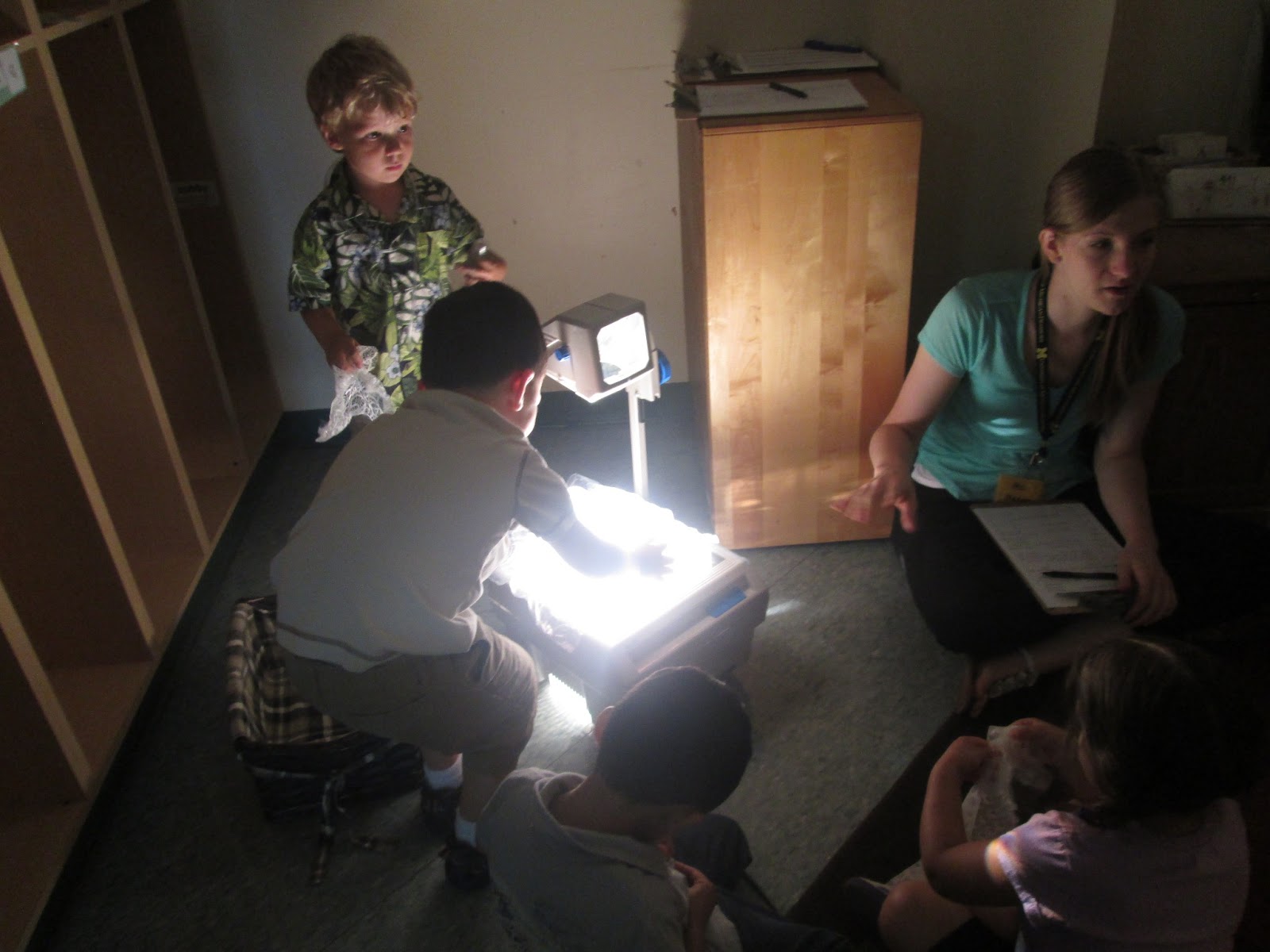
 The children have been exploring how the light projects images onto the wall. The children have been interested in how the image changes as they layer objects onto each other. As children piled materials onto the projector, one of the children noticed, "It's hard to see the different designs when they are on top of each other." The children also began to notice how the image on the wall changed depending on where they were standing. If they were close to the projector, the image was big. If they were standing near the wall in front of the light, the image was smaller.


 As the week progressed, the children became more interested in how the water looked as it was moving inside the bottle. "It's shaking in the bottle and moving on the wall!"

Roads & Pathways


 Another avenue of exploration has been the road blocks. We have been leaving their work on the floor so that each day they can make changes to the paths. They have created a closed circuit so that cars can travel in a continuous path. The teachers challenged the children to build a structure where the roads crossed but cars could travel without disturbing other cars . The children found the bridge pieces and were able to build bridges over the roads so that cars could cross each other without crashing.  

In future activities we will add details around the road using materials from the classroom.

Wednesday, May 29, 2013

Bird House

How can we help the birds to find the birdhouse?
Problem Solving: May 28, 2013 A.M.

The last few weeks the children have been working on constructing a bird house. They first worked together to figure out how to fit the pieces together.  After a few days of trial with fitting the pieces together the children came up with a plan and drew their ideas down on how to construct the house.  Once they had their plans we worked on practicing with hammers and nails.  We had Mr. Gary came down to drill some holes in pieces of wood to help us get it started. The children worked for a few days to complete the bird house, which is now hanging outside the classroom door.  


Group Meeting: Conversation About the Bird House

Emilio: We can make the birdhouse darker!
Jenna: We could use birdseed and put it on a track and have it stop by the birdhouse.
Deena: We could put the food on top of the birdhouse!
Jamil: We could put birdseed in the birdhouse.
Katie: We could put some birdseed on the ground by the birdhouse.
Emilio: We could tweet and make bird calls and noises to help lead the birds there.
Deena: We could tweet and use food.
Natalie: Maybe we can put a small flashlight in the birdhouse so it won’t be dark and they can see their food.

Emilio: We can use worms because birds like them and chipmunks do not.

Pajama Day!

Dear Families,

The children have been asking to have a pajama day.  We all decided to have a Pajama day on Thursday, June 6th.  If your child would like to participate in the pajama day please have them wear appropriate pajamas to school.

Thank you,

 Ms. Finkelstein & Ms. Muehlenbein